New Research Chair for Mountain Hazard at the University of Geneva supported by the AXA Foundation for Human Progress
Climate change is rapidly escalating disaster risks in mountains, and notably in the Alps. Melting glaciers, shrinking snow cover and thawing permafrost are destabilizing mountains, triggering more rockfalls, debris flows and cascading hazards that threaten communities and infrastructure. At the same time, hotter summers and more intense storms are fueling sudden, high-impact events floods. To tackle these growing risks, the University of Geneva (UNIGE) has launched a new chair thanks to the support of the AXA Foundation for Human Progress, to study changes in mountain disaster risks. The chair will focus in particular on debris flows and their impacts across the Swiss, French, Austrian, German and Italian Alps.
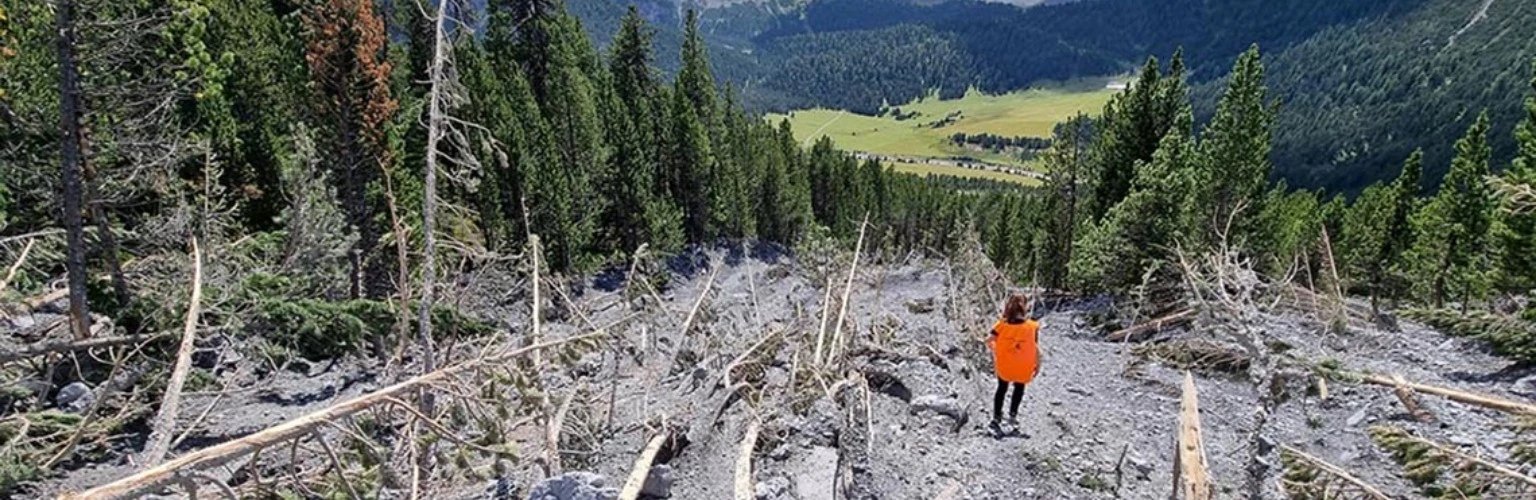
On July 25, 2022, an extreme local storm at Piz Nair (Engadine, Switzerland) triggered a debris flow affecting forest, infrastructure, and roads.
Sudden and fast — they can exceed 50 km/h — debris flows rush down mountain torrents with tremendous force. These destructive mixtures of water, debris, soil and rocks sweep away boulders and tree trunks along their path. They occur when water mobilizes loose debris on steep slopes of at least 25%. Increasingly common in summer and autumn, often triggered by intense thunderstorms or diluvial rains, these phenomena amplified by climate change pose a growing threat to infrastructure and mountain societies.
The occurrence of debris flows in the European Alps often leads to casualties and causes damage amounting to several hundred million Swiss francs. In summer 2024, for instance, a cluster of violent storms unleashed destructive debris flows across the Alps, affecting southern Switzerland (Val Bavona, Valle Maggia), northern Italy (Valle d’Aosta and Piedmont), as well as parts of Austria and Germany. It caused widespread damage, including buried roads, damaged bridges, and the destruction of homes and power infrastructure.
The new AXA Chair in Mountain Disaster Risks at UNIGE will examine how climate warming, changing precipitation patterns, glacier retreat, and permafrost degradation influence the frequency, magnitude, and impacts of different types of gravitational natural hazards in mountain regions. It will provide a comprehensive approach to quantify and evaluate future mass-movement risks and help define strategies, together with public and private actors, to limit loss and damage in the future.
Our university’s mission goes beyond generating scientific knowledge. It must address solutions to the major challenges facing our societies, starting with climate change. With the creation of this new chair, we fully embrace this dual ambition.
Audrey Leuba Rector of UNIGE
Protecting what really matters is AXA’s core purpose, and by supporting this new chair, we help ensure that risks are identified at an early stage. This knowledge is crucial for taking the right measures to minimize the impact of these risks on the environment and society.
Monika Wieneke Actuarial & Security and member of the executive board at AXA Switzerland
We are proud to support the innovative research of this new chair at UNIGE, which will provide invaluable insights to help foster more resilient conditions for local communities—today and for generations to come
Clément Rouxel General Delegate for the AXA Foundation for Human Progress
Markus Stoffel, a specialist in climate related risks, the chair will build on two decades of experience and combine field observations, remote sensing and process modelling to better understand where and when slopes fail, how far destructive flows can travel, and what this means for exposed communities and critical infrastructure.
Integrated within the Section of Earth and Environmental Sciences of the Faculty of Science, it will receive EUR 200,000 per year for five years from the AXA Foundation for Human Progress – the endowment fund of AXA Mutuelles d’Assurances companies and the AXA Group. It will be developed in collaboration with the Department F.-A. Forel for Environmental and Aquatic Sciences, the Department of Earth Sciences and the Institute for Environmental Sciences (ISE) and will host three PhD candidates as well as two senior researchers, one of whom 50%.
The new chair will offer a unique opportunity to study the impact of changing climatic conditions on mass-movement risks in the European Alps. The rock-ice avalanche in Blatten last year or the fatal debris flows in summer 2024 underscore the pressing need to improve understanding of these processes and their dynamics. While we won’t be able to avoid the occurrence of these phenomena in the future, we can certainly mitigate the resulting damage.
Markus Stoffel UNIGE Professor
The Science pillar of the AXA Foundation for Human Progress is committed to supporting innovative research programmes that contribute to societal progress. Funding for the new chair follows a highly competitive call for proposals launched by the foundation and overseen by a scientific committee, through which Markus Stoffel’s project was selected from more than one hundred applications.
About the University of Geneva
Founded in 1559, the University of Geneva (UNIGE) now ranks among the top 100 universities worldwide. As a versatile institution with international reach, it fully integrates into the international landscape of Geneva while also contributing to the cultural, social, and economic development of the region. UNIGE is a member of the League of European Research Universities (LERU) and the 4EU+ European alliance, with its research quality being internationally recognised. It has been honoured with numerous distinctions, including several Nobel Prizes and Fields Medals. UNIGE hosts nearly 18,000 students from 150 countries across its nine faculties and thirteen interfaculty centres.
Keep reading